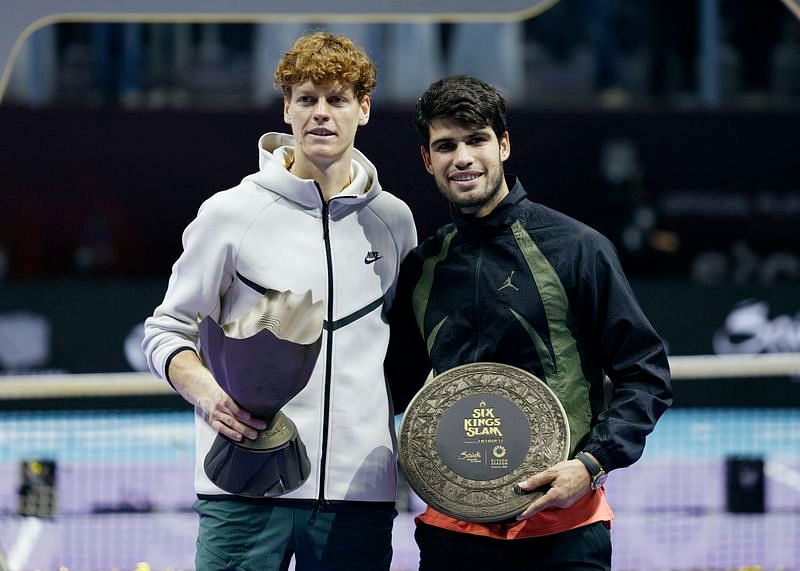
In the mid-afternoon in Los Angeles but prime time in Riyadh, Jannik Sinner overcame a lost first set tiebreak to defeat Carlos Alcaraz in the final of the 6 Kings Slam exhibition (6(5)-7, 6-3, 6-3). Up 4-1 in the first, Sinner hit a few unforced errors that allowed Alcaraz to recover the break and ultimately the set. But the world #1 tightened the screws in the second and third sets, obtaining crucial breaks at 3-3* in both sets to secure the $6 million prize. A week removed from his victory in Shanghai, Sinner came to Riyadh and defeated, in my eyes, the other three best players in the world.
What a year it has been for Sinner. Since the start of 2024, the carrot-haired Italian has captured six titles, two majors, and achieved his first stint as world #1 (which he will retain through year-end). With a 65-6 record to date, there can be little debate that Sinner is, at lowest, the second-best player in the world. Dating back to a tremendous end of his 2023 season, the potential for Sinner to achieve such heights was always latent. Perhaps his consecutive victories for Italy over Novak Djokovic prior to the Australian Open were indications that the Italian was going to reach those levels this year.
Despite all the achievement and applause, the fanfare seems a bit subdued. Perhaps it’s the lack of tennis coverage and hype in America. But for my money, I think there’s still a lot going on in the background of Sinner’s clostebol scandal. For those unfamiliar, in August the International Tennis Integrity Agency (ITIA) announced that Sinner tested positive for one-billionth of a gram of an anabolic steroid called clostebol. This led to the ultimate stripping of his prize money and ranking points from the Indian Wells tournament, when the incident first occurred. The ITIA ultimately acquitted Sinner of any wrongdoing, but a recent appeal from World Anti-Doping Agency (WADA) has challenged this claim in the Court of Arbitration for Sport. The basis of this appeal is not challenging that Sinner had any wrongdoing in the matter; rather, that the level of negligence on Sinner’s part was not entirely absent but still that it played no significant part in the matter.
There was some shock across the board when the ITIA’s decision was appealed, but I understand WADA’s rationale for challenging the ruling. Applying the same standards across all levels of athletes is important and one that has been challenged in the wake of Sinner’s case. For an organization like WADA, there must be both standardization of the treatment of athletes and of the application of rules. This will not be the last doping scandal that comes out of tennis, so WADA’s insurance of a just investigation and outcome for a case this high profile will set the standard. In the tennis world especially, inequality of treatment between top and lower ranked players are the subject of many debates. These disparities exist even in the upper echelons of the game between people ranked in the top 4 versus the top 15. Just look at Simona Halep’s case. People pointed to Sinner’s lack of provisional suspension that was so prevalent in Halep’s case as a sign of preferential treatment. How do you explain the difference in these situations to casual tennis viewers who won’t read the nitty-gritty of each case? I don’t think there’s a clear answer to this question. On one hand, organizations like WADA, the ATP, and the ITIA should always push for equality and fair treatment. But underlying all sports organizations like the ATP there will always be a monetary motive.
Though I understand the need for provisional suspensions, players like Halep are more often than not innocent of intentional doping. Most of these players probably aren’t in Halep’s position to retire and be financially stable. This could be their one chance to make it. I sympathize with these players (obviously excluding those who intentionally dope for performance enhancing effects). There will no doubt be innocent players in the future that will not get the same benefit of the doubt or leash as Sinner. But the reality is that the way the organization and tennis world is constructed, the doping oversight may always be somewhat unfair.
Let’s look at this from an abstract view. The most important assets to the ATP will always be the players, and in this moment, Sinner is the ATP’s golden carrot. The suspension of a player like Sinner hurts no one more than the organizations themselves. As unjust as it is, there’s a level of priority that will always be given to the top performers because the financial health of the institutions relies on them. Whether or not that factors into an independent tribunal’s thought process cannot be empirically stated, but I do think it’s interesting to consider that tennis, as a whole, suffers when the stars don’t shine due to its independent nature. It’s not all sunshine for these individuals though, they also must bear the cross of public scrutiny for all their actions. Just look at any social media site after Novak displays an ounce of personality. No matter the outcome of WADA’s appeal, there will always be X users that classify Sinner as a doper. Whether that’s fair or not, it’s just how it is. Sinner will likely have to answer for this scandal for the duration of his career. Regardless, the doping system is interconnected between these for-profit organizations with independent oversees playing referee. The importance of the independent authority is huge because it theoretically ends all preferential treatment. But I think the criticism of the ITIA’s processes is more than justified after seeing the differences in investigations between Sinner and other players.
The question is: Does this background noise detract or alter the accomplishments that Sinner has achieved?
Under the assumption that Sinner is innocent, I think this makes his 2024 even more impressive. With the way these athletes are tested, if Sinner was consistently doping, I believe it would have been caught far earlier. But if tests are capable of picking up a billionth of a gram, it’s hard for me to believe that something wouldn’t have slipped up earlier if he was seeking performance enhancement. Regardless, he won the Australian Open in dominant fashion before this scandal even broke out and started the year 16-0. He did so by making Novak, a 10x Australian Open champion, look like an unseeded player in the SFs. After this, he proceeded to win Rotterdam and Miami before an “underwhelming clay-court season” where he made the SFs at Roland-Garros. Captured a title on grass in Halle before dominating the US hard court at Cincinnati and the US Open. The only player even close to Sinner’s level of consistency and dominance this year was Alcaraz (which speaks to how incredible he is). To do this all with the whole world essentially calling him a cheater, speaks to how incredibly mature and strong Sinner is mentally. I think we forget that this guy is 23 years old. Everyone always made a big deal of his physical limitations and shortcomings, and finally, at the end of last year, his physical ability reached an elite level. The guy was a mental rock so young, and this was the time I felt that he was challenged in that respect as a top, top player. You can’t ask for a better response to that challenge than what Sinner did in 2024. Still lots to play for this season, so we could yet see Sinner add to his already historic year.
 Margin Call Sports
Leave a comment